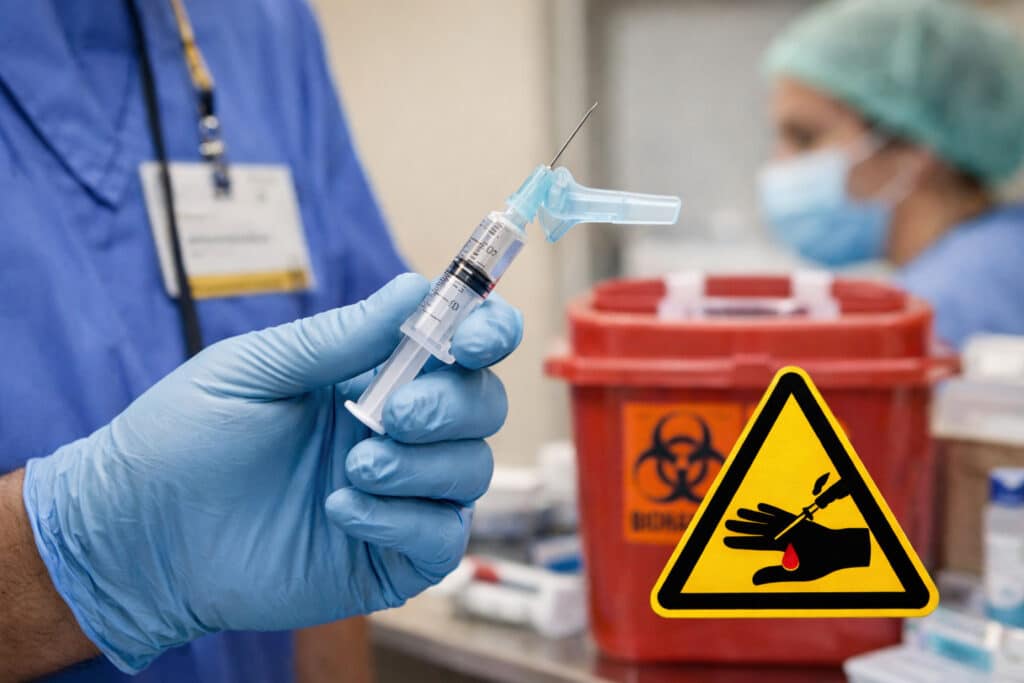
Needlestick and other sharps injuries are a serious hazard in any healthcare setting. Contact with
contaminated needles, scalpels, broken glass, and other sharps may expose healthcare workers to
blood that contains pathogens which pose a grave, potentially lethal risk. ACTIVITIES WITH
POTENTIAL FOR NEEDLESTICK INJURIES Home healthcare workers can be at risk for
needlestick or sharps injuries when they:
- Handle needles that must be taken apart or manipulated after use.
- Dispose of needles attached to tubing.
- Manipulate the needle in the client.
- Recap a needle.
- Use needles or glass equipment to transfer body fluid between containers.
- Fail to dispose of used needles in puncture-resistant sharps containers.
- Lack proper workstations for procedures using sharps.
- Work quickly.
- Bump into a needle, a sharp, or another worker while either person is holding a sharp.
EMPLOYERS SHOULD
- Eliminate the use of needle devices whenever safe and effective alternatives are available.
- Provide needle devices with safety features.
- Provide sharps containers for workers to bring into clients’ homes.
- Investigate all sharps-related injuries.
- Provide post-exposure medical evaluations.
EMPLOYEES SHOULD
- Avoid using needles whenever safe and effective alternatives are available.
- Avoid recapping or bending needles that might be contaminated. How to Prevent Needlestick
and Sharps Injuries
- Bring standard-labeled, leak-proof, puncture-resistant sharps containers to clients’ homes.
Do not assume such containers will be available there. Promptly dispose of used needle devices and
sharps, which might be contaminated, in the containers.
- Plan for the safe handling and disposal of needles before use.
- Store sharps containers out of the reach of children, pets, and others not needing access. •
Secure used sharps containers during transport to prevent spilling.
- Follow standard precautions, infection prevention, and general hygiene practices
consistently.
- Participate in your employer’s bloodborne pathogens training program.
- Help your employer select and evaluate devices with safety features.
- Use devices with safety features provided by your employer.
- Report any needlestick and other sharps injury immediately to your employer. If you
experience a needlestick or sharps injury or are exposed to the blood or other body fluid of a client
during the course of your work, immediately follow these steps:
- Wash needlesticks and cuts with soap and water.
- Flush splashes to the nose, mouth, or skin with water.
- Irrigate eyes with clean water, saline, or sterile irrigants.
- Report the incident to your supervisor.
- Immediately seek medical treatment.
Q&A
- Needlestick injuries are hazardous to healthcare workers True or false
- List two scenarios whereby HHAs are at risk of needlestick injuries
- To avoid needlestick injuries, caregivers should _ (list one care procedure)
- As an HHA, it is important to avoid using needles when safe alternatives are available T or F
- If you experience a needlestick injury, what must one immediately do?
- Promptly disposing of used needle devices and sharps, which might be contaminated, in the
containers is a
a. Means of keeping client and aide safe (safety proceedure)
b. Means of addressing a needlestick injury (after-injury porceedure)
- General hygiene practices are important means of avoiding needlestick injuries. Briefly
explain
- Report any needlestick and other sharps injury immediately to your employer. True or false
- Explain what a needlestcik injury is
- HHA workers engage in activities with potential needlestick injuries. List two